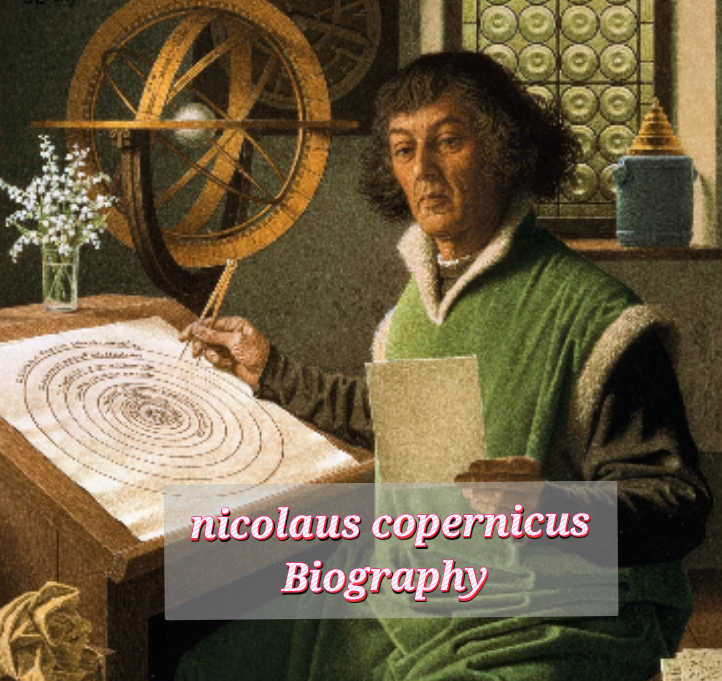
Nicolaus Copernicus Biography
Nicolaus Copernicus was a key figure in the history of science. Born in 1473 and living until 1543, he is best known for his idea that the Sun, not Earth, sits at the center of our planetary system. This view, called the heliocentric theory, went against what most people believed for centuries. At that time, the common belief was the geocentric model, where Earth stayed fixed in the middle, and the Sun, Moon, planets, and stars moved around it.
Copernicus was a Renaissance thinker with skills in many areas. He worked as a church official, doctor, and economist, but astronomy was his true passion. His main book, De revolutionibus orbium coelestium (On the Revolutions of the Heavenly Spheres), came out in the year he died. It explained his ideas with math and observations. Though he delayed sharing his full work due to fear of criticism, his theory started a big change in how humans see the universe. It helped lead to the Scientific Revolution, where evidence and reason became more important than old teachings.
This article looks at his life step by step. It covers his early years, learning, work, the details of his theory, personal matters, debates it caused, and his lasting impact. The goal is to make his story clear and easy to follow.
Nicolaus Copernicus Early Life and Background
Nicolaus Copernicus was born on February 19, 1473, in Toruń, a city in Royal Prussia. This area was part of the Kingdom of Poland at the time. His family spoke German and came from a merchant background. His father, also named Nicolaus, traded in copper and other goods. His mother, Barbara Watzenrode, belonged to a respected local family.
Copernicus was the youngest of four children. His siblings were Andreas, Barbara, and Katharina. When his father died around 1483 or 1485, young Nicolaus was about 10 years old. His uncle, Lucas Watzenrode, stepped in to care for him. Lucas was a bishop in the Warmia region and had strong ties to the church. He made sure his nephew got a good education and later helped him find a stable job in the church.
The region where Copernicus grew up mixed Polish, German, and other influences. It had seen wars, like the Thirteen Years’ War against the Teutonic Order. But life for his family was comfortable due to trade. This background gave him access to learning and church positions, which shaped his future.
Nicolaus Copernicus Education
Copernicus started his studies with a focus on the liberal arts. In 1491, at age 18, he went to the University of Kraków. There, he learned subjects like mathematics, philosophy, and astronomy. He studied under teachers such as Albert Brudzewski, who taught about the stars and planets. Kraków had a strong program in these areas, and Copernicus began collecting books on astronomy.
After four years, he moved to Italy for more study. From 1496 to 1500, he attended the University of Bologna. He focused on canon law, the rules of the church, but he also worked on astronomy. He lived with Domenico Maria Novara, an astronomy professor, and made observations, like one of the star Aldebaran in 1497.
Next, from 1501 to 1503, he studied medicine at the University of Padua. Medicine at that time included some astrology. In 1503, he earned a doctorate in canon law from the University of Ferrara, though he did not attend classes there long-term.
His education made him a well-rounded person. He learned Greek, read ancient works, and gained practical skills. This mix of law, medicine, and astronomy helped him think in new ways later.
Nicolaus Copernicus Career
After his studies, Copernicus returned to Poland in 1503. His uncle had secured him a position as a canon in the Warmia chapter. This role involved church duties, like managing lands and collecting rents. He lived mostly in Frombork, near the Baltic Sea, where he had a tower for observations.
Copernicus handled many tasks. He helped defend the area during conflicts with the Teutonic Order in 1519 to 1521. He treated patients as a doctor, using his medical knowledge. He also wrote about money matters. In the 1520s, he suggested reforms to stop bad coins from driving out good ones, an idea later called Gresham’s law.
He took part in local meetings and helped run estates. His work kept him busy, but he always found time for the stars. He set up simple tools in his tower to watch planets and the Moon. His career showed he was practical and trusted in his community.
Nicolaus Copernicus The Heliocentric Theory Explained
For over a thousand years, people followed Ptolemy’s geocentric model. In it, Earth was still, and everything else circled around it using complex paths called epicycles to explain odd movements like planets going backward in the sky.
Copernicus thought there was a better way. Around 1508 to 1514, he wrote a short paper called Commentariolus. It said the Sun is near the center, and planets, including Earth, move around it in circles.
His full ideas appeared in De revolutionibus in 1543. The main points are:
- The Sun is the center of the planetary system.
- Earth spins once a day on its axis, causing day and night.
- Earth orbits the Sun once a year, causing seasons.
- Other planets orbit the Sun too, in order: Mercury, Venus, Earth, Mars, Jupiter, Saturn.
- The stars are very far away, so they seem fixed.
- Earth’s slow wobble explains changes in star positions over long times.
This model used fewer complex parts than Ptolemy’s and made planetary speeds match their distance from the Sun. It explained why some planets appear to move backward: it is due to Earth passing them. Though Copernicus kept some small circles for accuracy, his idea was simpler and more natural.
He based it on math, old ideas from thinkers like Aristarchus, and his own observations. It was a big shift from seeing Earth as special to seeing it as one moving planet.
Nicolaus Copernicus Personal Life
Copernicus never married and had no children. As a church canon, he took vows of celibacy. From around 1531 to 1539, he had a housekeeper named Anna Schilling. She was related through family ties and helped run his home. Church officials, including bishops, saw this as improper and asked him to end the arrangement. Anna left Frombork in 1539.
Records show no proof of anything beyond a close household bond. Copernicus lived a quiet life focused on duties and study. He cared for family members, like nieces and nephews, after his sister’s death.
He died on May 24, 1543, at age 70, from a stroke in Frombork. He received his book on his deathbed.
Nicolaus Copernicus Controversies and Initial Reception
Copernicus knew his ideas would upset people. The Bible has passages that seem to say the Sun moves, like in Joshua where it stands still. He delayed full publication for years.
A student, Georg Joachim Rheticus, helped print the book in 1543. An unsigned preface by Andreas Osiander said the theory was just a math tool, not truth, to soften reactions.
Some Protestants, like Martin Luther, called it foolish and against Scripture. Catholic leaders were mixed at first. Pope Clement VII heard about it earlier without strong objection. But later, in 1616, the Church placed the book on a banned list until corrections.
The main issue was not science alone but how it fit with religious views. Over time, proof from Galileo, Kepler, and Newton supported Copernicus, and his work gained acceptance.
Conclusion
Nicolaus Copernicus changed our view of the world. His heliocentric theory showed Earth moves and is not the center. This opened the door to modern science, where observation and math guide understanding.
He lived as a dedicated churchman and scholar. His quiet work, published at the end of his life, sparked lasting progress. Today, we honor him as a pioneer who encouraged questioning and seeking truth.
FAQs
What is Nicolaus Copernicus best known for?
He is best known for the heliocentric theory, which places the Sun at the center with planets orbiting it.
Where did Nicolaus Copernicus study?
He studied at the University of Kraków, University of Bologna, University of Padua, and earned his canon law doctorate from the University of Ferrara.
What are three facts about Copernicus?
He was a polymath skilled in astronomy, medicine, law, and economics. He proposed Earth rotates and orbits the Sun. His major book was published in 1543, the year he died.
Did Copernicus have a wife?
No, he never married. He had a controversial living arrangement with his housekeeper Anna Schilling.
How did Copernicus die?
He died on May 24, 1543, from a stroke at age 70 in Frombork.
What did Copernicus discover?
He developed the heliocentric model, correctly ordered the planets, and explained retrograde motion through Earth’s movement.
Why was Copernicus’s theory controversial?
It challenged the long-held geocentric view and seemed to conflict with some Bible passages, leading to debates in religious circles.